
>
>
>
>
When the future is uncertain, your EVP needs to be built for it
...
...
When the future is uncertain, your EVP needs to be built for it
When the future is uncertain, your EVP needs to be built for it

Most organisations treat their Employee Value Proposition (EVP) as a retrospective exercise. Research the culture. Capture what's good. Package it. Launch it. Review it in three years. That approach made sense when the world of work was relatively stable. It doesn't any more.
The organisations navigating this moment well are the ones that have stopped thinking about EVP as a fixed document and started treating it as a framework for evolution. One that can move with the organisation to withstand AI adoption, skills transformation and a talent landscape that looks nothing like it did five years ago.
EVP and people strategy are the same conversation
EVP doesn't sit alongside people strategy. It’s people strategy, made visible. It captures not just what an organisation offers today but where it's headed. The skills it's building, the capabilities it's investing in and the relationship it's forging between human talent and digital tools.
That's a harder brief than it used to be. How do you build a compelling proposition around a three-to-five year horizon, when that horizon keeps shifting? How do you attract people for skills that are still emerging? How do you position an organisation as a place where people will thrive when the shape of work itself is changing?
Ruth Prowse, Consultant at Two Degrees Below, says:
“The organisations we’ve seen doing this well aren't trying to predict the future. They're building an EVP that's honest about the journey. That takes more courage than most people realise, but it's the only version that holds up."
The answer is not to pretend you have all the answers. It's to build an EVP that's honest about the journey. One that’s grounded in genuine culture and founding experience, but explicit about the growth, reskilling and evolution ahead. Possibility, but grounded. That combination is rare. And it's exactly what the best talent is looking for.
Why the say-do gap is still the biggest risk
None of this works if the gap between promise and reality is too wide to bridge. And right now, that gap is wider than most leaders realise.
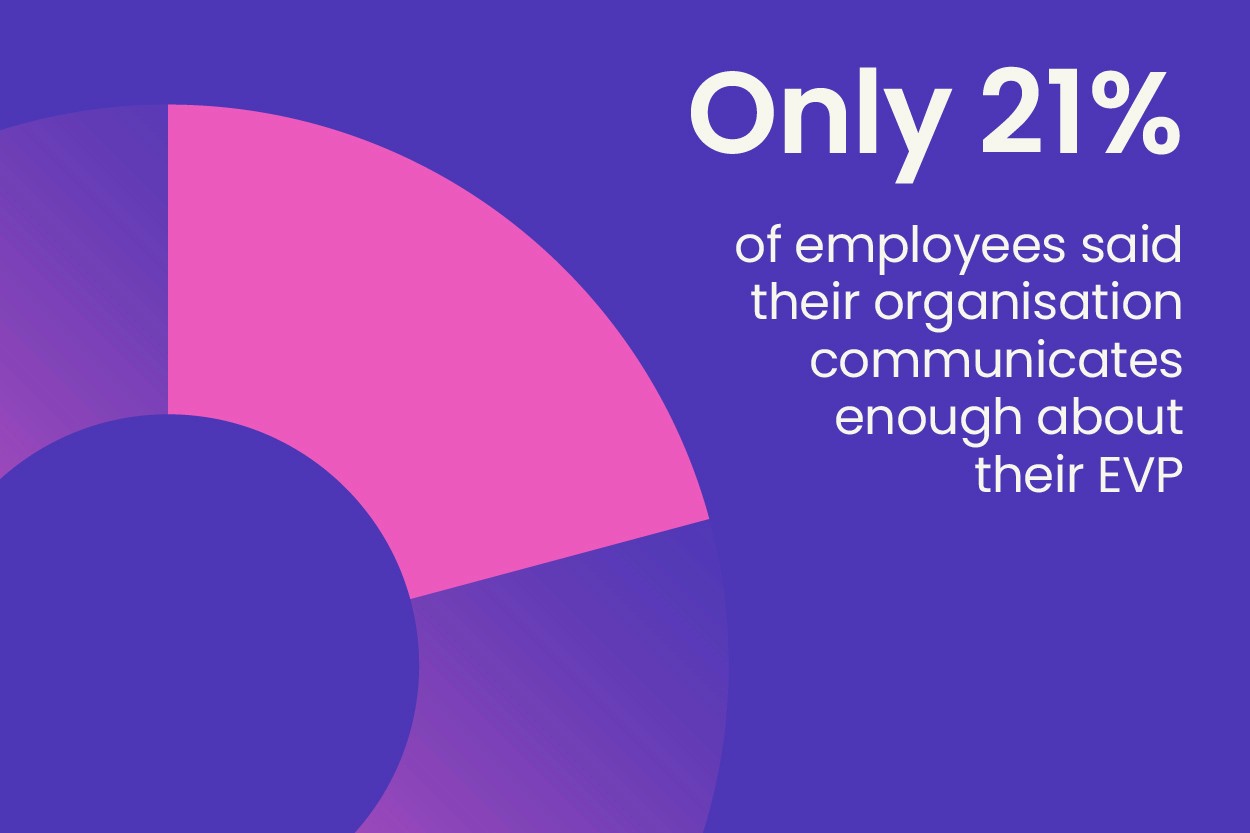
Research from Gartner found that only 21 per cent of employees said their organisation communicates enough about their EVP. Only one third said their organisation consistently delivers on its promises and just 16 per cent knew what their EVP actually contains.
These numbers point to something important. Most EVP investment goes into the message and very little into the mechanism or embedding it. The day-to-day conditions, behaviours and ways of working that make the promise real.
Ruth adds:
“The moments when EVP work really lands are when a leadership team stops asking 'how do we tell this story?' and starts asking 'is this story true?' That shift — from narrative to reality — is where the real work begins.”
An EVP built purely on aspiration rather than evidence will always underdeliver. When the pillars don't reflect what people experience, employees don't just disengage. They stop believing.
An evolutionary EVP makes this challenge sharper, not easier. If you're asking people to commit to a journey, they need to believe you're committed too. That means being transparent about where you are now, honest about what's still being built and clear about what the organisation is doing to get there.
Built to move
The best EVPs right now have a fixed core and a fluid edge. The core captures the authentic experience of working in the organisation — the culture, the values, the environment that already exists. The fluid edge is where the evolution lives: the skills agenda, the human-digital relationship, the growth story.
Organisations that get this right aren't just building a stronger employer brand. They're building the internal conditions for the future they say they want. One where people understand the direction, believe in the journey and have the skills to make it happen.
That's not a document you review every three years. That's a living commitment. To your people, your strategy and the organisation you're becoming. The ones that treat it that way won't just attract better talent. They'll be better placed to keep it, grow it and take it somewhere worth going.
Most organisations treat their Employee Value Proposition (EVP) as a retrospective exercise. Research the culture. Capture what's good. Package it. Launch it. Review it in three years. That approach made sense when the world of work was relatively stable. It doesn't any more.
The organisations navigating this moment well are the ones that have stopped thinking about EVP as a fixed document and started treating it as a framework for evolution. One that can move with the organisation to withstand AI adoption, skills transformation and a talent landscape that looks nothing like it did five years ago.
EVP and people strategy are the same conversation
EVP doesn't sit alongside people strategy. It’s people strategy, made visible. It captures not just what an organisation offers today but where it's headed. The skills it's building, the capabilities it's investing in and the relationship it's forging between human talent and digital tools.
That's a harder brief than it used to be. How do you build a compelling proposition around a three-to-five year horizon, when that horizon keeps shifting? How do you attract people for skills that are still emerging? How do you position an organisation as a place where people will thrive when the shape of work itself is changing?
Ruth Prowse, Consultant at Two Degrees Below, says:
“The organisations we’ve seen doing this well aren't trying to predict the future. They're building an EVP that's honest about the journey. That takes more courage than most people realise, but it's the only version that holds up."
The answer is not to pretend you have all the answers. It's to build an EVP that's honest about the journey. One that’s grounded in genuine culture and founding experience, but explicit about the growth, reskilling and evolution ahead. Possibility, but grounded. That combination is rare. And it's exactly what the best talent is looking for.
Why the say-do gap is still the biggest risk
None of this works if the gap between promise and reality is too wide to bridge. And right now, that gap is wider than most leaders realise.
Research from Gartner found that only 21 per cent of employees said their organisation communicates enough about their EVP. Only one third said their organisation consistently delivers on its promises and just 16 per cent knew what their EVP actually contains.
These numbers point to something important. Most EVP investment goes into the message and very little into the mechanism or embedding it. The day-to-day conditions, behaviours and ways of working that make the promise real.
Ruth adds:
“The moments when EVP work really lands are when a leadership team stops asking 'how do we tell this story?' and starts asking 'is this story true?' That shift — from narrative to reality — is where the real work begins.”
An EVP built purely on aspiration rather than evidence will always underdeliver. When the pillars don't reflect what people experience, employees don't just disengage. They stop believing.
An evolutionary EVP makes this challenge sharper, not easier. If you're asking people to commit to a journey, they need to believe you're committed too. That means being transparent about where you are now, honest about what's still being built and clear about what the organisation is doing to get there.
Built to move
The best EVPs right now have a fixed core and a fluid edge. The core captures the authentic experience of working in the organisation — the culture, the values, the environment that already exists. The fluid edge is where the evolution lives: the skills agenda, the human-digital relationship, the growth story.
Organisations that get this right aren't just building a stronger employer brand. They're building the internal conditions for the future they say they want. One where people understand the direction, believe in the journey and have the skills to make it happen.
That's not a document you review every three years. That's a living commitment. To your people, your strategy and the organisation you're becoming. The ones that treat it that way won't just attract better talent. They'll be better placed to keep it, grow it and take it somewhere worth going.
Ready to dive deeper?
Ready to
dive deeper?

Taste, experience, creativity: today's real competitive advantage
Taste, experience, creativity: today's real competitive advantage
Two Degrees Below
Two Degrees Below
AI has handed everyone the same capabilities and tech competency isn't the competitive edge it once was. Three of our own go deep on the ideas that are, and what they really mean for the brands we work with.
AI has handed everyone the same capabilities and tech competency isn't the competitive edge it once was. Three of our own go deep on the ideas that are, and what they really mean for the brands we work with.
Read more
The four signals every change plan needs right now
The four signals every change plan needs right now
Two Degrees Below
Two Degrees Below
Four signals from MAD//Fest 2026 on experimenting, emotion and ownership — and what they mean for the change plan you're building right now.
Four signals from MAD//Fest 2026 on experimenting, emotion and ownership — and what they mean for the change plan you're building right now.
Read more