
>
>
>
>
Most organisations claim storytelling. Almost none practise it.
...
...
Most organisations claim storytelling. Almost none practise it.
Most organisations claim storytelling. Almost none practise it.

Is the plan for your change effort imaginable? Can your people envision their place in it? Strip away the launch decks and all-hands scripts and what you usually find is messaging. Polished and consistent. Yet almost entirely ineffective at changing what people believe or do.
Research on narrative transportation consistently shows that stories are better retained and more likely to change beliefs than equivalent information presented as data or argument.
Messaging tells people what to think. Storytelling places people inside an experience and lets them draw their own conclusions. One produces compliance. The other produces conviction. Conviction is what moves organisations. And conviction cannot be briefed into existence.
Where it breaks down
You've probably seen this play out. Leadership commissions a narrative. Comms develops it. It launches with high production values. Two weeks later, everything goes quiet. And two structural problems sit underneath this that almost never get addressed.
Problem 1: Lack of ownership
Leaders receive the story as a finished script and recite it rather than tell it. But you can’t authentically deliver a story you didn’t build. The audience detects the distance, and trust erodes rather than builds.
This problem has deepened significantly with AI.
Consulting Director, Matt Ede, says: “In a workshop with 200 senior leaders, we asked how many had sent AI-generated communications without reading or editing the output first. Roughly two-thirds raised their hands. Put bluntly, a leader who outsources their voice is failing at the most fundamental part of the job.”
Problem 2: Limited range
It’s common for organisations to only ever invest in one type of story: the strategy story. It’s typically told once at launch and not again. Strategy stories establish where the organisation is going and why the journey is worth making. But without progress stories – proof that the strategy is becoming real – the strategy story becomes an empty promise. And without possibility stories – open challenges that invite people to imagine and create without a predetermined conclusion – there’s no genuine participation. Only compliance.
Matt adds: "Possibility stories are the most underused and arguably the most powerful. They require a leader to pose a question they don’t yet have the answer to. That kind of public uncertainty is undervalued in most professional environments. So organisations wait for conclusions before communicating. The window for genuine participation closes. And people learn that the story is something that happens to them, not something they are part of."
What you can do now
Action 1: Auditing where you are takes honesty, not resource.
Ask your leadership team to tell the story of the current change effort in their own words. If the answers are inconsistent, scripted or vague, you have a storytelling problem, not a communications problem. That distinction matters because the solutions are different.
Action 2: Check which types of stories you’re actually telling.
Have you communicated a progress story in the last month? Have you ever told a possibility story? One that genuinely invites people in rather than informs them of a decision already made. If the answer is no, that’s where your narrative is losing people.
Action 3: Look at where your stories originate.
The most credible storytelling organisations don’t just push narratives downward. Instead, they create structures that surface real stories from the people doing the work. Frontline voices, genuinely platformed rather than curated into corporate case studies, are more believable than any leadership broadcast. Leaders who listen to and amplify frontline stories are more credible than leaders who simply transmit.
Where the harder work lies
The self-audit is fast. The fix is not. Closing the gap between storytelling as claimed and storytelling as practised requires three things to be true simultaneously:
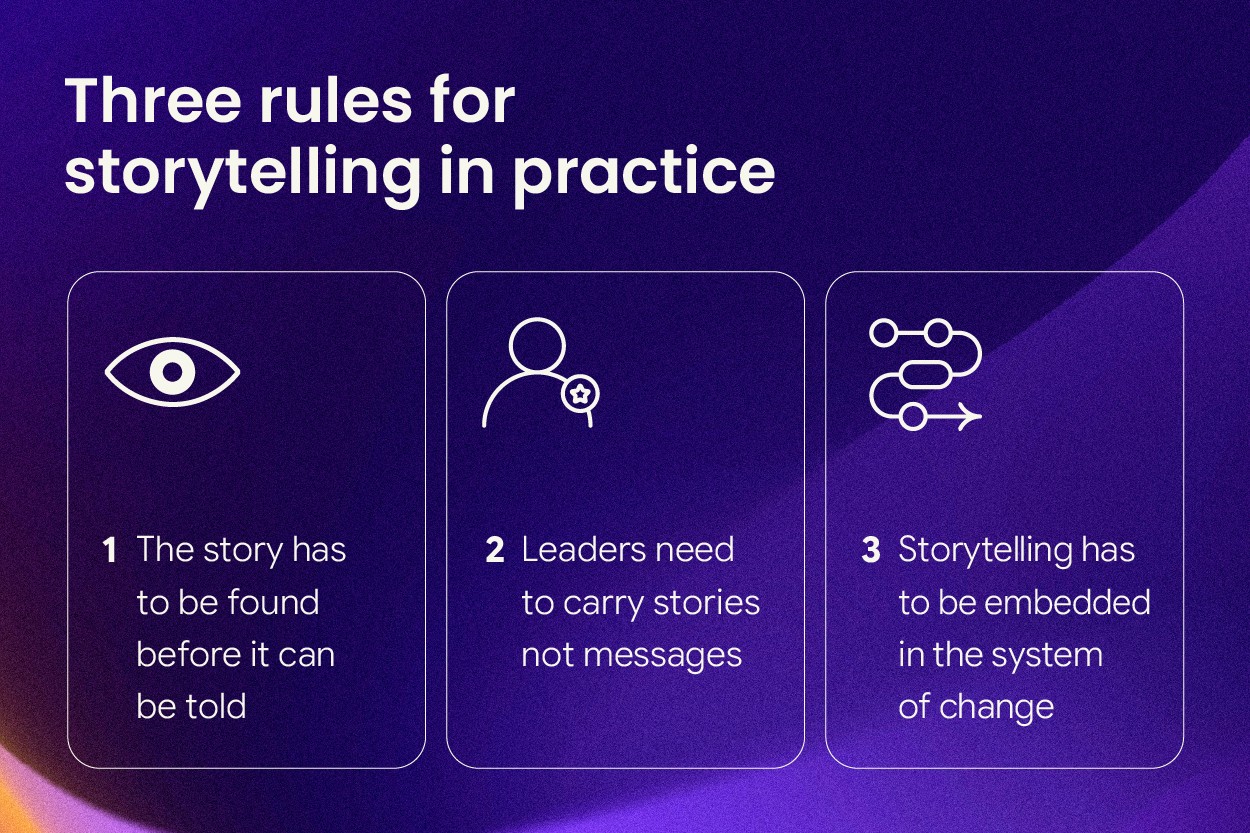
The story has to be found before it can be told
Leaders need to carry stories not messages
Storytelling has to be embedded in the system of change, not bolted on at launch and left to fade.
The temptation is to start with the narrative and work backwards, fitting evidence around a message leadership has already decided on. We do the opposite. We start with structured insight: listening sessions, perception audits, honest conversations about what people actually believe, fear and experience. The story coming from that process has a quality no amount of craft can manufacture because employees recognise it as true rather than learning to ignore it.
Most organisations already sense the gap. They just haven't named it yet. We can help you close it.
Is the plan for your change effort imaginable? Can your people envision their place in it? Strip away the launch decks and all-hands scripts and what you usually find is messaging. Polished and consistent. Yet almost entirely ineffective at changing what people believe or do.
Research on narrative transportation consistently shows that stories are better retained and more likely to change beliefs than equivalent information presented as data or argument.
Messaging tells people what to think. Storytelling places people inside an experience and lets them draw their own conclusions. One produces compliance. The other produces conviction. Conviction is what moves organisations. And conviction cannot be briefed into existence.
Where it breaks down
You've probably seen this play out. Leadership commissions a narrative. Comms develops it. It launches with high production values. Two weeks later, everything goes quiet. And two structural problems sit underneath this that almost never get addressed.
Problem 1: Lack of ownership
Leaders receive the story as a finished script and recite it rather than tell it. But you can’t authentically deliver a story you didn’t build. The audience detects the distance, and trust erodes rather than builds.
This problem has deepened significantly with AI.
Consulting Director, Matt Ede, says: “In a workshop with 200 senior leaders, we asked how many had sent AI-generated communications without reading or editing the output first. Roughly two-thirds raised their hands. Put bluntly, a leader who outsources their voice is failing at the most fundamental part of the job.”
Problem 2: Limited range
It’s common for organisations to only ever invest in one type of story: the strategy story. It’s typically told once at launch and not again. Strategy stories establish where the organisation is going and why the journey is worth making. But without progress stories – proof that the strategy is becoming real – the strategy story becomes an empty promise. And without possibility stories – open challenges that invite people to imagine and create without a predetermined conclusion – there’s no genuine participation. Only compliance.
Matt adds: "Possibility stories are the most underused and arguably the most powerful. They require a leader to pose a question they don’t yet have the answer to. That kind of public uncertainty is undervalued in most professional environments. So organisations wait for conclusions before communicating. The window for genuine participation closes. And people learn that the story is something that happens to them, not something they are part of."
What you can do now
Action 1: Auditing where you are takes honesty, not resource.
Ask your leadership team to tell the story of the current change effort in their own words. If the answers are inconsistent, scripted or vague, you have a storytelling problem, not a communications problem. That distinction matters because the solutions are different.
Action 2: Check which types of stories you’re actually telling.
Have you communicated a progress story in the last month? Have you ever told a possibility story? One that genuinely invites people in rather than informs them of a decision already made. If the answer is no, that’s where your narrative is losing people.
Action 3: Look at where your stories originate.
The most credible storytelling organisations don’t just push narratives downward. Instead, they create structures that surface real stories from the people doing the work. Frontline voices, genuinely platformed rather than curated into corporate case studies, are more believable than any leadership broadcast. Leaders who listen to and amplify frontline stories are more credible than leaders who simply transmit.
Where the harder work lies
The self-audit is fast. The fix is not. Closing the gap between storytelling as claimed and storytelling as practised requires three things to be true simultaneously:
The story has to be found before it can be told
Leaders need to carry stories not messages
Storytelling has to be embedded in the system of change, not bolted on at launch and left to fade.
The temptation is to start with the narrative and work backwards, fitting evidence around a message leadership has already decided on. We do the opposite. We start with structured insight: listening sessions, perception audits, honest conversations about what people actually believe, fear and experience. The story coming from that process has a quality no amount of craft can manufacture because employees recognise it as true rather than learning to ignore it.
Most organisations already sense the gap. They just haven't named it yet. We can help you close it.
Ready to dive deeper?
Ready to
dive deeper?

What your AI gender adoption gap is telling you about leadership
What your AI gender adoption gap is telling you about leadership
Two Degrees Below
Two Degrees Below
Your AI adoption data is showing you something more useful than usage rates. It's showing you who feels safe enough to experiment, and who doesn't. Here's why the gap is a leadership problem, not a skills one.
Your AI adoption data is showing you something more useful than usage rates. It's showing you who feels safe enough to experiment, and who doesn't. Here's why the gap is a leadership problem, not a skills one.
Read more

Taste, experience, creativity: today's real competitive advantage
Taste, experience, creativity: today's real competitive advantage
Two Degrees Below
Two Degrees Below
AI has handed everyone the same capabilities and tech competency isn't the competitive edge it once was. Three of our own go deep on the ideas that are, and what they really mean for the brands we work with.
AI has handed everyone the same capabilities and tech competency isn't the competitive edge it once was. Three of our own go deep on the ideas that are, and what they really mean for the brands we work with.
Read more