
SXSW London 2026: The future is human, not technological
SXSW London 2026: The future is human, not technological
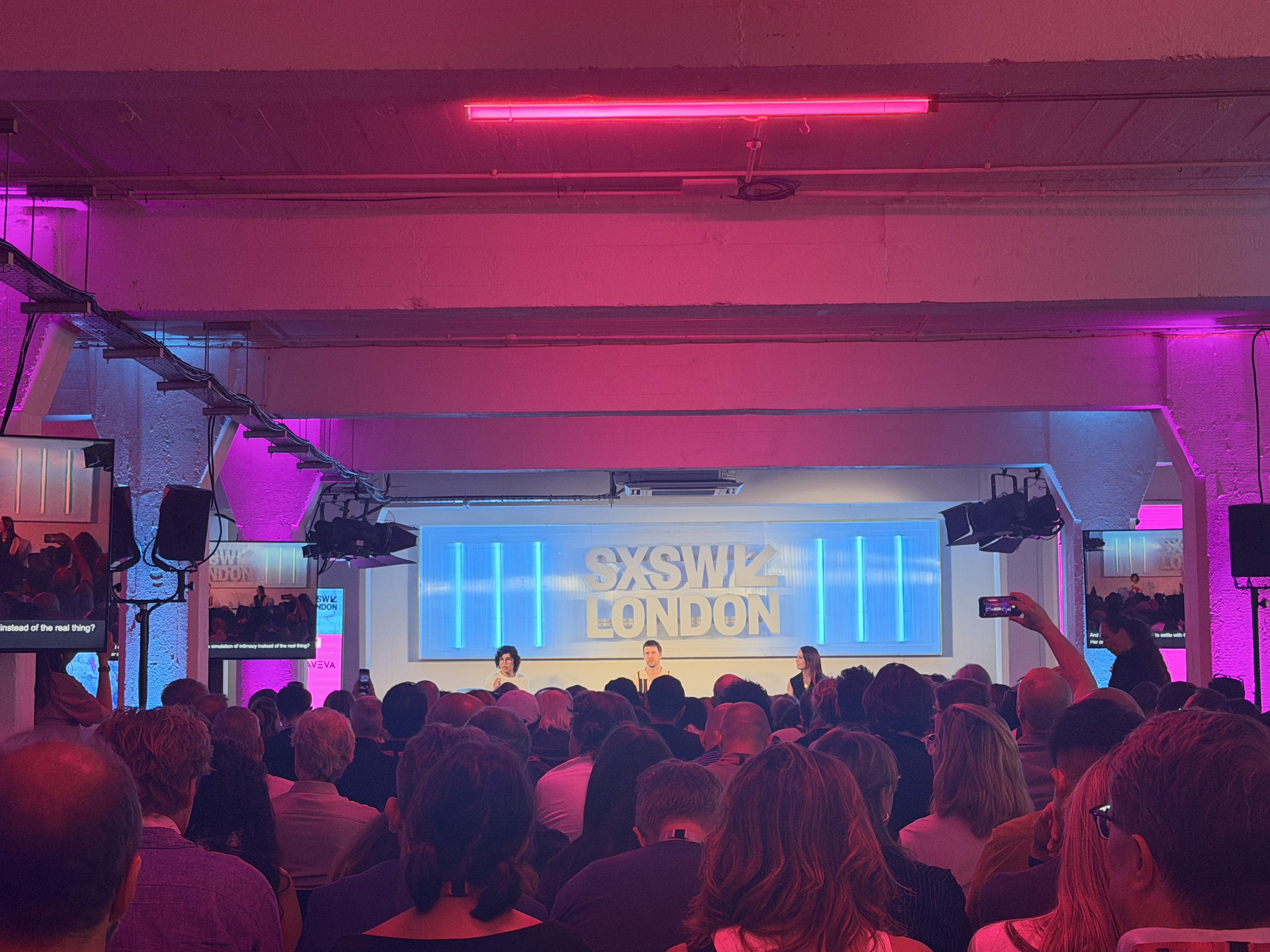
For the second year running, SXSW London set up shop on our doorstep in Shoreditch. So naturally, we threw ourselves into it again. One week, dozens of sessions and speakers ranging from advertising legends to challenger founders later, a handful of ideas refused to leave us. Here they are.
Businesses are bolting AI onto old ways of working and wondering why nothing’s changed
When factories first switched from steam power to electric motors, productivity actually went down. As Marc Warner of Faculty and Accenture explained, they'd swapped the engine but kept the layout the same – so nothing really improved. The breakthrough only came when they redesigned everything around the new technology. The former is what organisations are doing with AI right now.
It’s a tension that came up again and again across the week. Victor Riparbelli, CEO of Synthesia made a counterintuitive point about what he called “net negative productivity” – AI makes it so easy to generate long, polished content that we’re now all producing far more than anyone can actually read. Saving ten minutes writing something. Only to cost twenty-five colleagues reading it for five minutes each, isn’t a productivity gain. Faster and more, as it turns out, aren’t the same as better and efficient.
So, where does the real value sit? For Andrew McAfee at MIT Sloan, it's in the people. AI is giving people at every level the ability to just do things without needing technical skills or a six-month sign-off process.
As our Content Strategist, Sen Thackeray, put it: “McAfee said it best for me. If you want to thrive as an organisation, you need to be smart enough not to squash that energy when it starts coming from the bottom up. It’s not about the organisations that have the biggest AI budgets anymore.”
To illustrate what squashing looks like, he pulled up a screenshot from the Academy of Management – an institution literally dedicated to advancing management thinking – announcing that AI tools are banned from their review process.
Point made.
Creativity is the engine, not an optional extra
Sir John Hegarty walked on stage, told the room they didn't have to agree with anything he said, and added – in rather stronger terms – that he didn't much care whether they did. Strong open.
His argument: business schools are flawed because they teach everything except the thing that drives growth. They prioritise process. But business isn't a process, it's an idea. Setting up a business is a creative act. And creativity, he argued, can’t be bolted on – it has to be structural and wired into how the whole organisation is built.
The McKinsey research he pointed to made the commercial case: the most creative companies score far higher on both total shareholder returns and organic revenue growth than the least creative. He even floated renaming the CEO the Creative Executive Officer – cheeky, but it makes sense. If creativity drives growth, why isn't it at the top of the org chart?
David Lee, Chief Brand and Creative Officer at Squarespace, picked up the same thread from a different angle. He thinks that art school is the new MBA. The skills drilled into you there – creativity, critique and craft – are exactly the ones business needs now.
For us, it’s a point that gains real urgency in the age of AI. When everyone has access to the same generative tools and the same prompts, technical capability stops being a differentiator. What's left – taste, point of view, the ability to have an idea worth having – is precisely the human stuff. Creativity isn't the soft, optional layer at the end of the process. Increasingly, it's the competitive advantage.
Trust is three things and most brands only understand the first
“The session with Suresh Balaji of Lloyds Banking Group and Sairah Ashman of Wolff Olins was a favourite of mine," said Sen. "It gave such a simple but crucial framework for how trust actually works.”
After 250 years in business, Lloyds ran a national study to understand how people really think about trust. It breaks down into three dimensions:
Trust in character: does this brand do the right thing?
Trust in competence: does this brand do what it says?
Trust in credibility: is this brand vouched for by voices people believe?
For most of history, legacy brands have lived on character. Competence was assumed – nobody worried whether their bank was good at banking. But social media changed the rules and created that third dimension. And here's the thing, credibility no longer has to come from a credible source. It can come from anyone with a phone and a following, which is exactly why so many young people now take financial advice from strangers on TikTok over a 250-year-old institution.
The same novelty-to-trust shift surfaced elsewhere too. A panel on the "anti-trend economy" with voices from Capsule, Amazon Fashion and Vinted argued that the emotional driver in how people buy has moved from novelty to trust. Being first to the trend used to be an advantage, but increasingly, it's a liability. What earns loyalty now is consistency, relevance and being genuinely right for the person in front of you.
As Sen said: "The implication for any organisation navigating change is that good values are no longer enough. You have to prove your competence at every interaction and show up in the spaces where credibility is being built."
People are looking for experiences worth showing up for
Several threads at SXSW London converged here.
Grainne Wafer of Diageo and Elisa Gregori of Nestlé argued that culture-led branding has reached a tipping point. So much of it now feels like empty imitation that consumers are starting to question whether any of it is authentic, and chasing short-term cultural relevance can erode the brand equity that took years to build.
Their answer: real experiences. Genuine, crafted moments people want to be part of.
As our Creative Director Dani Batty put it: "People want proximity. Genuine, crafted moments. The desire for authentic touchpoints has never been more strongly felt and we're seeing it come to the fore in briefs from our clients too."
A session on immersive experience design, featuring Coca-Cola's Rapha Abreu, made the same point from another angle: technology is the enabler, not the experience. What matters isn't the spectacle or the scale – it's whether every moment reinforces the same feeling.
Ultimately, experience can't be an afterthought, bolted on at the end as a one-off activation. It has to be designed into everything because that's where people form the memories and the feelings that keep them coming back.
The thread that ran through everything
The thing that kept surfacing was a very old question: how do you make people feel something? That's the challenge worth taking back into your own organisation. Because the shift that matters most isn't technological. It's human. And ensuring that shift happens, is exactly our business. Let’s talk.
For the second year running, SXSW London set up shop on our doorstep in Shoreditch. So naturally, we threw ourselves into it again. One week, dozens of sessions and speakers ranging from advertising legends to challenger founders later, a handful of ideas refused to leave us. Here they are.
Businesses are bolting AI onto old ways of working and wondering why nothing’s changed
When factories first switched from steam power to electric motors, productivity actually went down. As Marc Warner of Faculty and Accenture explained, they'd swapped the engine but kept the layout the same – so nothing really improved. The breakthrough only came when they redesigned everything around the new technology. The former is what organisations are doing with AI right now.
It’s a tension that came up again and again across the week. Victor Riparbelli, CEO of Synthesia made a counterintuitive point about what he called “net negative productivity” – AI makes it so easy to generate long, polished content that we’re now all producing far more than anyone can actually read. Saving ten minutes writing something. Only to cost twenty-five colleagues reading it for five minutes each, isn’t a productivity gain. Faster and more, as it turns out, aren’t the same as better and efficient.
So, where does the real value sit? For Andrew McAfee at MIT Sloan, it's in the people. AI is giving people at every level the ability to just do things without needing technical skills or a six-month sign-off process.
As our Content Strategist, Sen Thackeray, put it: “McAfee said it best for me. If you want to thrive as an organisation, you need to be smart enough not to squash that energy when it starts coming from the bottom up. It’s not about the organisations that have the biggest AI budgets anymore.”
To illustrate what squashing looks like, he pulled up a screenshot from the Academy of Management – an institution literally dedicated to advancing management thinking – announcing that AI tools are banned from their review process.
Point made.
Creativity is the engine, not an optional extra
Sir John Hegarty walked on stage, told the room they didn't have to agree with anything he said, and added – in rather stronger terms – that he didn't much care whether they did. Strong open.
His argument: business schools are flawed because they teach everything except the thing that drives growth. They prioritise process. But business isn't a process, it's an idea. Setting up a business is a creative act. And creativity, he argued, can’t be bolted on – it has to be structural and wired into how the whole organisation is built.
The McKinsey research he pointed to made the commercial case: the most creative companies score far higher on both total shareholder returns and organic revenue growth than the least creative. He even floated renaming the CEO the Creative Executive Officer – cheeky, but it makes sense. If creativity drives growth, why isn't it at the top of the org chart?
David Lee, Chief Brand and Creative Officer at Squarespace, picked up the same thread from a different angle. He thinks that art school is the new MBA. The skills drilled into you there – creativity, critique and craft – are exactly the ones business needs now.
For us, it’s a point that gains real urgency in the age of AI. When everyone has access to the same generative tools and the same prompts, technical capability stops being a differentiator. What's left – taste, point of view, the ability to have an idea worth having – is precisely the human stuff. Creativity isn't the soft, optional layer at the end of the process. Increasingly, it's the competitive advantage.
Trust is three things and most brands only understand the first
“The session with Suresh Balaji of Lloyds Banking Group and Sairah Ashman of Wolff Olins was a favourite of mine," said Sen. "It gave such a simple but crucial framework for how trust actually works.”
After 250 years in business, Lloyds ran a national study to understand how people really think about trust. It breaks down into three dimensions:
Trust in character: does this brand do the right thing?
Trust in competence: does this brand do what it says?
Trust in credibility: is this brand vouched for by voices people believe?
For most of history, legacy brands have lived on character. Competence was assumed – nobody worried whether their bank was good at banking. But social media changed the rules and created that third dimension. And here's the thing, credibility no longer has to come from a credible source. It can come from anyone with a phone and a following, which is exactly why so many young people now take financial advice from strangers on TikTok over a 250-year-old institution.
The same novelty-to-trust shift surfaced elsewhere too. A panel on the "anti-trend economy" with voices from Capsule, Amazon Fashion and Vinted argued that the emotional driver in how people buy has moved from novelty to trust. Being first to the trend used to be an advantage, but increasingly, it's a liability. What earns loyalty now is consistency, relevance and being genuinely right for the person in front of you.
As Sen said: "The implication for any organisation navigating change is that good values are no longer enough. You have to prove your competence at every interaction and show up in the spaces where credibility is being built."
People are looking for experiences worth showing up for
Several threads at SXSW London converged here.
Grainne Wafer of Diageo and Elisa Gregori of Nestlé argued that culture-led branding has reached a tipping point. So much of it now feels like empty imitation that consumers are starting to question whether any of it is authentic, and chasing short-term cultural relevance can erode the brand equity that took years to build.
Their answer: real experiences. Genuine, crafted moments people want to be part of.
As our Creative Director Dani Batty put it: "People want proximity. Genuine, crafted moments. The desire for authentic touchpoints has never been more strongly felt and we're seeing it come to the fore in briefs from our clients too."
A session on immersive experience design, featuring Coca-Cola's Rapha Abreu, made the same point from another angle: technology is the enabler, not the experience. What matters isn't the spectacle or the scale – it's whether every moment reinforces the same feeling.
Ultimately, experience can't be an afterthought, bolted on at the end as a one-off activation. It has to be designed into everything because that's where people form the memories and the feelings that keep them coming back.
The thread that ran through everything
The thing that kept surfacing was a very old question: how do you make people feel something? That's the challenge worth taking back into your own organisation. Because the shift that matters most isn't technological. It's human. And ensuring that shift happens, is exactly our business. Let’s talk.
Ready to dive deeper?
Ready to
dive deeper?

What your AI gender adoption gap is telling you about leadership
What your AI gender adoption gap is telling you about leadership
Two Degrees Below
Two Degrees Below
Your AI adoption data is showing you something more useful than usage rates. It's showing you who feels safe enough to experiment, and who doesn't. Here's why the gap is a leadership problem, not a skills one.
Your AI adoption data is showing you something more useful than usage rates. It's showing you who feels safe enough to experiment, and who doesn't. Here's why the gap is a leadership problem, not a skills one.
Read more

Taste, experience, creativity: today's real competitive advantage
Taste, experience, creativity: today's real competitive advantage
Two Degrees Below
Two Degrees Below
AI has handed everyone the same capabilities and tech competency isn't the competitive edge it once was. Three of our own go deep on the ideas that are, and what they really mean for the brands we work with.
AI has handed everyone the same capabilities and tech competency isn't the competitive edge it once was. Three of our own go deep on the ideas that are, and what they really mean for the brands we work with.
Read more