
Complexity lives in your processes. And in your people.
Complexity lives in your processes. And in your people.

Most leaders have been here. The initiative launched well. The workshops were energising. The roadmap looked clean. And then, six months later, the meetings are just as long, the sign-off chains are just as convoluted, and the energy has quietly drained away.
Simplification programmes fail all the time. Not because the process design was wrong. Not because the technology wasn't right. They fail because the people inside the organisation – with their habits, fears, incentives and unspoken rules – were never really part of the plan.
It's a more common problem than most leaders realise. Research from McKinsey finds that two-thirds of executives view their organisations as overly complex and inefficient, yet the complexity keeps coming back. The question worth asking is why.
The wrong diagnosis
When organisations decide to simplify, they typically reach for the familiar toolkit: process maps, governance reviews, system upgrades. These things matter. But they treat complexity as if it's a technical problem with a technical solution.
Increasingly, AI is being positioned as the answer to this. But AI applied to complex, dysfunctional systems produces a faster, more expensive version of the same problem. Technology can process complexity. It can’t resolve the human dynamics that created it.
Complexity is both a structural and a human problem. And it often only surfaces when people need to work laterally across the organisation. Yes, it lives in legacy processes that have evolved in isolation and in systems that were never designed to talk to each other. But it also lives in the culture, in the way decisions get made, in the behaviours leaders model every day. Fix one without the other and the complexity grows back. The organisations that make real progress treat both as part of the same challenge.
Two Degrees Below Consultant, Ruth Prowse, says:
"In our experience, the organisations that struggle most with simplification are often the ones that have tried it before. A long-tenure workforce that has seen previous campaigns come and go develops a kind of protective cynicism. By the time the next initiative launches, people have already decided it won't stick."
When employees hear ‘simplification’, many assume it’s the organisation’s job to fix, not theirs. The red tape, the legacy systems, the approval chains – those feel institutional, not personal. And they’re not wrong. But that perception creates a gap. While senior leaders wait for process redesigns to land, and employees wait for the business to change around them, the everyday behaviours that generate complexity carry on unchallenged.
Why leaders accidentally make it worse
One of the more uncomfortable truths in our work is this: leaders often reward complexity without knowing it. They praise thoroughness over speed. They request more stakeholders in the room. They create decision-making environments where clarity is actually riskier than ambiguity. Because ambiguity means you're never wrong.
"I've worked with a leading financial services organisation that decided to quantify what slow decision-making was actually costing them,” says Ruth. “The number was significant and it changed the conversation entirely. It's much harder to deprioritise simplification when the cost of complexity is sitting on a spreadsheet in front of you."
Research from the Behavioural Insights Team reinforces this: organisations that focus purely on communications and training without redesigning the environment around people will see new behaviours fail to take hold. The environment has to make simplicity the easier choice, not the braver one. Employees pick this up quickly. When the environment signals that escalating a decision is safer than making it, people escalate. When being busy is a badge of status, people stay busy.
And complexity isn’t always an accident, either. For some people, it’s useful. A process that only you understand secures your position. A project that requires constant sign off keeps you visible. Being busy – openly and demonstrably busy – is a badge of honour in most large organisations. Until people feel genuinely empowered to simplify and are held accountable for doing so or incentivised to change, many will default to the complexity that feels safe. That’s not a character flaw. It’s a rational response to the environment.
What successful simplification actually looks like
The organisations that genuinely simplify share something in common: they treat it as a culture change challenge from the start, not a process exercise.
That means leaders who visibly model simplicity. Who challenge unnecessary complexity in meetings, who protect their people's time, who create psychological safety to act without fear of blame. It means early, visible wins that build genuine momentum rather than managed messaging. And it means human-centred storytelling: connecting the work back to what it unlocks for customers and colleagues, not just what it saves on a spreadsheet.
Crucially, it also means embedding simplicity into the daily rhythm of the organisation. The rituals – how meetings open, how decisions get recorded, how teams celebrate progress – are where culture actually lives. Without them, even the best-designed programme will fade.
Ruth adds: The organisations that make simplification stick, treat it the same way the best ones treat safety briefings. It becomes a ritual, not a reminder. When it stops being a campaign and starts being just how things are done around here, that's when you know something has genuinely shifted."
What to look for
The signals of genuine progress aren't just commercial. Faster decisions, improved retention, better customer scores. They're behavioural:
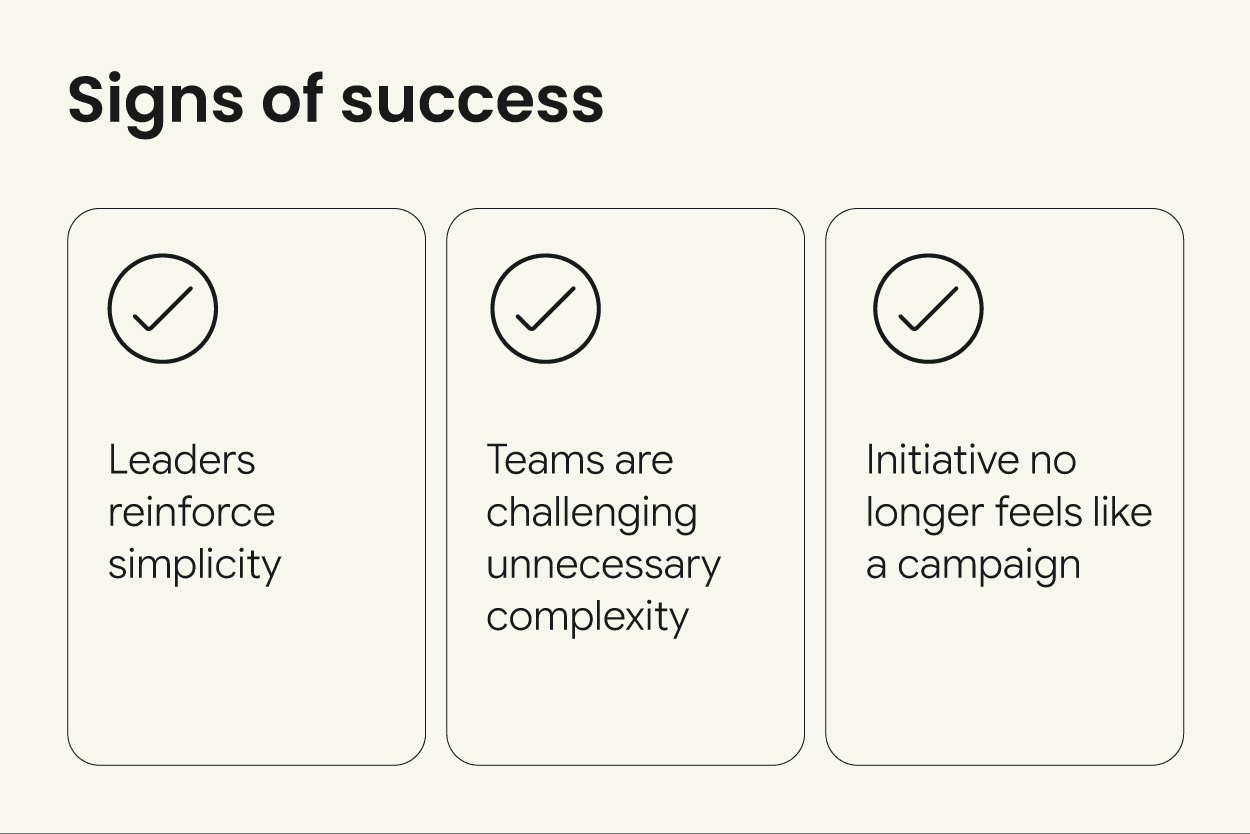
Leaders are actively reinforcing simplicity
Teams are challenging unnecessary complexity rather than absorbing it
The initiative no longer feels like a campaign; it feels like the way things work here
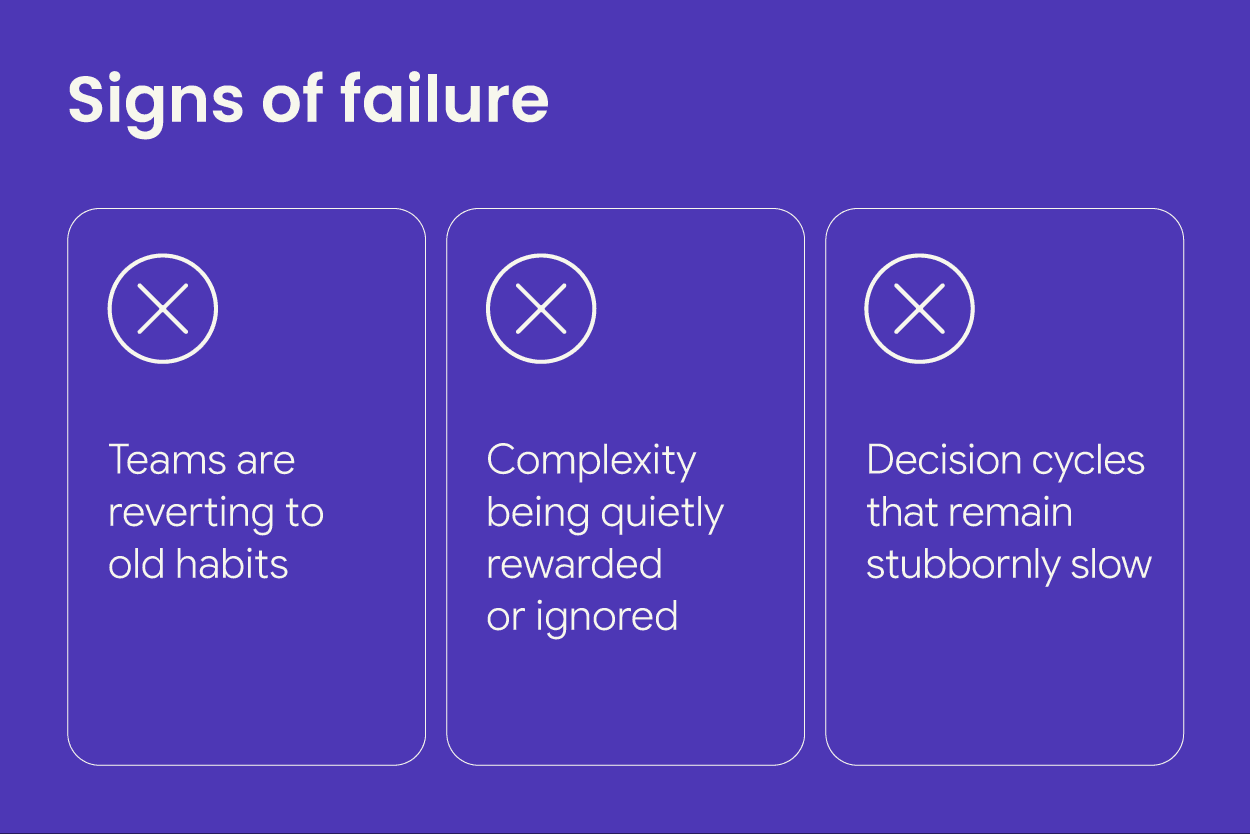
And the signals of failure are just as clear:
The reversion to old habits
Complexity being quietly rewarded or ignored
Decision cycles that remain stubbornly slow
The question worth asking
Before launching the next simplification initiative, it's worth asking a harder question than 'what do we need to change?' The more useful question is: what are we currently doing – as leaders, as an organisation – that's making complexity feel like the safer option?
The answer to that question is where the real work begins. And in our experience, that shift – however small – is where genuine simplification starts.
Most leaders have been here. The initiative launched well. The workshops were energising. The roadmap looked clean. And then, six months later, the meetings are just as long, the sign-off chains are just as convoluted, and the energy has quietly drained away.
Simplification programmes fail all the time. Not because the process design was wrong. Not because the technology wasn't right. They fail because the people inside the organisation – with their habits, fears, incentives and unspoken rules – were never really part of the plan.
It's a more common problem than most leaders realise. Research from McKinsey finds that two-thirds of executives view their organisations as overly complex and inefficient, yet the complexity keeps coming back. The question worth asking is why.
The wrong diagnosis
When organisations decide to simplify, they typically reach for the familiar toolkit: process maps, governance reviews, system upgrades. These things matter. But they treat complexity as if it's a technical problem with a technical solution.
Increasingly, AI is being positioned as the answer to this. But AI applied to complex, dysfunctional systems produces a faster, more expensive version of the same problem. Technology can process complexity. It can’t resolve the human dynamics that created it.
Complexity is both a structural and a human problem. And it often only surfaces when people need to work laterally across the organisation. Yes, it lives in legacy processes that have evolved in isolation and in systems that were never designed to talk to each other. But it also lives in the culture, in the way decisions get made, in the behaviours leaders model every day. Fix one without the other and the complexity grows back. The organisations that make real progress treat both as part of the same challenge.
Two Degrees Below Consultant, Ruth Prowse, says:
"In our experience, the organisations that struggle most with simplification are often the ones that have tried it before. A long-tenure workforce that has seen previous campaigns come and go develops a kind of protective cynicism. By the time the next initiative launches, people have already decided it won't stick."
When employees hear ‘simplification’, many assume it’s the organisation’s job to fix, not theirs. The red tape, the legacy systems, the approval chains – those feel institutional, not personal. And they’re not wrong. But that perception creates a gap. While senior leaders wait for process redesigns to land, and employees wait for the business to change around them, the everyday behaviours that generate complexity carry on unchallenged.
Why leaders accidentally make it worse
One of the more uncomfortable truths in our work is this: leaders often reward complexity without knowing it. They praise thoroughness over speed. They request more stakeholders in the room. They create decision-making environments where clarity is actually riskier than ambiguity. Because ambiguity means you're never wrong.
"I've worked with a leading financial services organisation that decided to quantify what slow decision-making was actually costing them,” says Ruth. “The number was significant and it changed the conversation entirely. It's much harder to deprioritise simplification when the cost of complexity is sitting on a spreadsheet in front of you."
Research from the Behavioural Insights Team reinforces this: organisations that focus purely on communications and training without redesigning the environment around people will see new behaviours fail to take hold. The environment has to make simplicity the easier choice, not the braver one. Employees pick this up quickly. When the environment signals that escalating a decision is safer than making it, people escalate. When being busy is a badge of status, people stay busy.
And complexity isn’t always an accident, either. For some people, it’s useful. A process that only you understand secures your position. A project that requires constant sign off keeps you visible. Being busy – openly and demonstrably busy – is a badge of honour in most large organisations. Until people feel genuinely empowered to simplify and are held accountable for doing so or incentivised to change, many will default to the complexity that feels safe. That’s not a character flaw. It’s a rational response to the environment.
What successful simplification actually looks like
The organisations that genuinely simplify share something in common: they treat it as a culture change challenge from the start, not a process exercise.
That means leaders who visibly model simplicity. Who challenge unnecessary complexity in meetings, who protect their people's time, who create psychological safety to act without fear of blame. It means early, visible wins that build genuine momentum rather than managed messaging. And it means human-centred storytelling: connecting the work back to what it unlocks for customers and colleagues, not just what it saves on a spreadsheet.
Crucially, it also means embedding simplicity into the daily rhythm of the organisation. The rituals – how meetings open, how decisions get recorded, how teams celebrate progress – are where culture actually lives. Without them, even the best-designed programme will fade.
Ruth adds: The organisations that make simplification stick, treat it the same way the best ones treat safety briefings. It becomes a ritual, not a reminder. When it stops being a campaign and starts being just how things are done around here, that's when you know something has genuinely shifted."
What to look for
The signals of genuine progress aren't just commercial. Faster decisions, improved retention, better customer scores. They're behavioural:
Leaders are actively reinforcing simplicity
Teams are challenging unnecessary complexity rather than absorbing it
The initiative no longer feels like a campaign; it feels like the way things work here
And the signals of failure are just as clear:
The reversion to old habits
Complexity being quietly rewarded or ignored
Decision cycles that remain stubbornly slow
The question worth asking
Before launching the next simplification initiative, it's worth asking a harder question than 'what do we need to change?' The more useful question is: what are we currently doing – as leaders, as an organisation – that's making complexity feel like the safer option?
The answer to that question is where the real work begins. And in our experience, that shift – however small – is where genuine simplification starts.
Ready to dive deeper?
Ready to
dive deeper?

What your AI gender adoption gap is telling you about leadership
What your AI gender adoption gap is telling you about leadership
Two Degrees Below
Two Degrees Below
Your AI adoption data is showing you something more useful than usage rates. It's showing you who feels safe enough to experiment, and who doesn't. Here's why the gap is a leadership problem, not a skills one.
Your AI adoption data is showing you something more useful than usage rates. It's showing you who feels safe enough to experiment, and who doesn't. Here's why the gap is a leadership problem, not a skills one.
Read more

Taste, experience, creativity: today's real competitive advantage
Taste, experience, creativity: today's real competitive advantage
Two Degrees Below
Two Degrees Below
AI has handed everyone the same capabilities and tech competency isn't the competitive edge it once was. Three of our own go deep on the ideas that are, and what they really mean for the brands we work with.
AI has handed everyone the same capabilities and tech competency isn't the competitive edge it once was. Three of our own go deep on the ideas that are, and what they really mean for the brands we work with.
Read more