>
>
>
>
Before you ask for more from your people, question your culture
...
...
Before you ask for more from your people, question your culture
Before you ask for more from your people, question your culture

Most leadership teams are asking the same question: How do we create a high performing team? But few understand why they keep missing the mark.
The term 'high-performance team' has become a blueprint everyone’s chasing. The idea that if your people perform, your business will too. But like most buzzwords, it only tells part of the story.
As Ruth Prowse, our Senior Consultant, puts it:
‘Many organisations know how to drive performance, they’re just not set up to sustain it.’’
Technology is innovating. AI is raising the bar. Market pressures are rising and most leaders are doubling down on employees to deliver more. However, the harder businesses push for performance, the more engagement erodes.
A recent study revealed that performance pressure is one of the strongest predictors of burnout. Coupled with Gallup's State of the Global Workplace 2026 report, which found that global employee engagement has been in decline for two years (dropping to just 20%), the pattern is hard to ignore.
Businesses are looking to drive high performance to solve business problems while teams are more checked out than ever.
So, what are they missing?
When ‘fixing’ behaviour doesn’t fix the problem
Organisations often define the traits of high-performing teams through a long list of behaviours like openness, alignment, customer obsession, resilience, agility, empowering behaviour and high psychological safety. All are valid. Most backed by data.
But here’s the problem: these behaviours zoom in on the individual. How people show up. How they act. Reinforcing the belief that organisational performance should be led by people performance. But teams are part of a wider system shaped by context, culture, pressure, leadership.
The uncomfortable truth is that disengagement and underperformance are not failures of effort. They’re symptoms of sustained stress and signs of a breakdown of trust between organisations and their people.
Edelman’s latest trust report revealed that 61% of people believe their companies make their lives harder, while burned out employees have 13% lower confidence in their performance. This suggests that asking for more from your people won’t work and is more likely to backfire.
Context matters
Teams are feeling the effects of the polycrisis (multiple global emergencies unfolding at the same time). A global pandemic, war and cost of living crises, means people are overwhelmed by shifting focuses and compounding expectations.
With no real recovery happening after these events and the added strain on personal wellbeing and income, employees are exhausted. Pulled in every direction and expected to deliver more with less.
Our Founder and Executive Creative Director, Dani Batty, put it like this:
“You can’t separate performance from lived realities. When the world feels unstable, work does too.”
Think structure, not behaviour
The issue isn't about whether people want to perform. It’s about whether the environment lets them. Right now, for most teams it doesn’t. Even in organisations chasing performance through simplification and transformation, the experience on the ground is often the opposite.
Work is complex. Systems are slow. Priorities compete. Decision making gets stuck. Layering expectations onto a system that’s not built for performance doesn’t create better outcomes. It increases friction.
Ruth added:
“Build the right environment and high performance follows. Get it wrong and your people don’t stand a chance.”
Shift the focus from output to conditions
If high performing teams are the outcome and winning traits like trust, alignment, resilience and accountability are markers of the right conditions – where should organisations start?
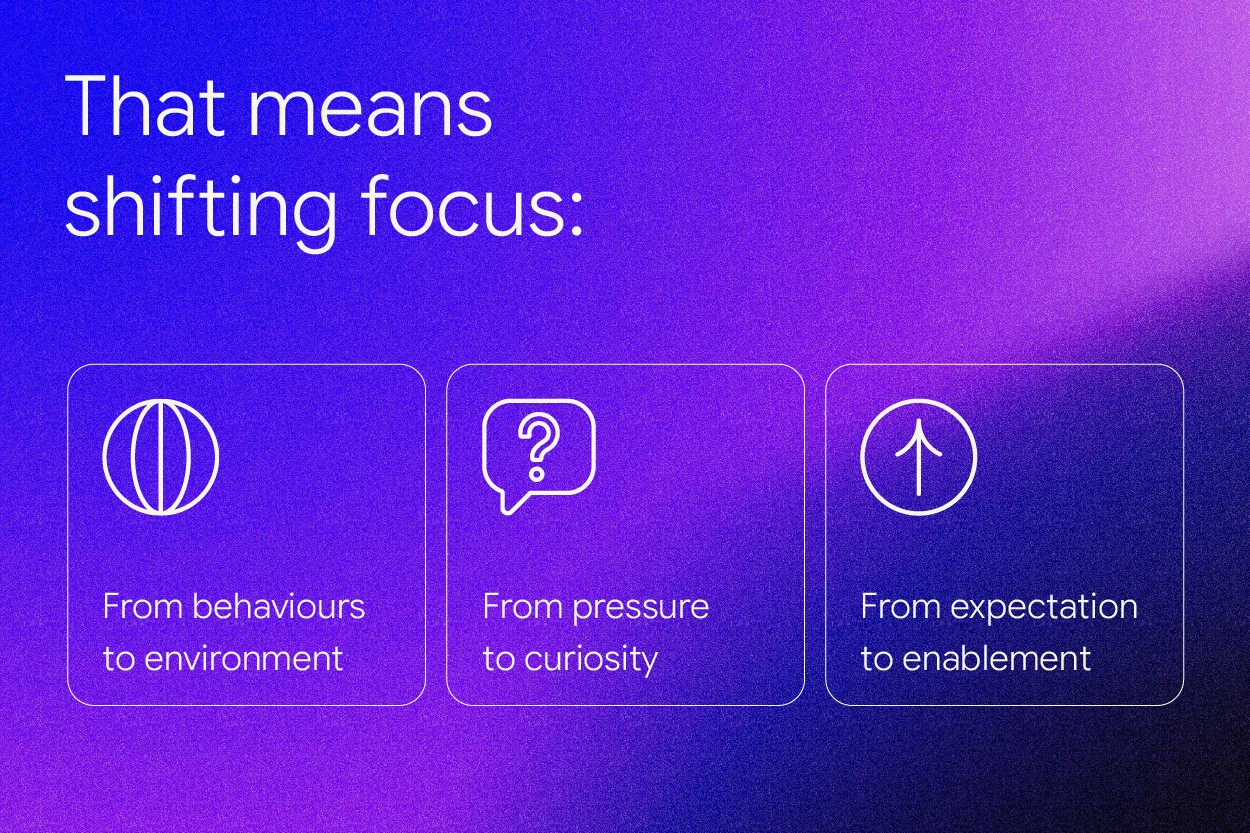
High-performing teams are not built through isolated behaviours. They are the by-product of a culture that enables them. And leadership is the force that shapes them. That means shifting focus:
From behaviours to environment
From pressure to curiosity
From expectation to enablement
Before you can ask people to perform at their best, the foundations need to be in place.
Can people do their jobs simply?
Do they have the tools they need?
Are priorities clear?
Do our systems support good decisions?
Are teams supported and aligned?
What leaders should be asking is: ‘What’s stopping our people from doing their best work?’ Until that’s answered, ‘high performing teams’ remains a buzzword your people can’t, and won’t, get behind.
Many organisations are feeling this friction, but few know how to fix it. When you’re ready to shift culture and unlock your people’s impact, let’s talk.
Most leadership teams are asking the same question: How do we create a high performing team? But few understand why they keep missing the mark.
The term 'high-performance team' has become a blueprint everyone’s chasing. The idea that if your people perform, your business will too. But like most buzzwords, it only tells part of the story.
As Ruth Prowse, our Senior Consultant, puts it:
‘Many organisations know how to drive performance, they’re just not set up to sustain it.’’
Technology is innovating. AI is raising the bar. Market pressures are rising and most leaders are doubling down on employees to deliver more. However, the harder businesses push for performance, the more engagement erodes.
A recent study revealed that performance pressure is one of the strongest predictors of burnout. Coupled with Gallup's State of the Global Workplace 2026 report, which found that global employee engagement has been in decline for two years (dropping to just 20%), the pattern is hard to ignore.
Businesses are looking to drive high performance to solve business problems while teams are more checked out than ever.
So, what are they missing?
When ‘fixing’ behaviour doesn’t fix the problem
Organisations often define the traits of high-performing teams through a long list of behaviours like openness, alignment, customer obsession, resilience, agility, empowering behaviour and high psychological safety. All are valid. Most backed by data.
But here’s the problem: these behaviours zoom in on the individual. How people show up. How they act. Reinforcing the belief that organisational performance should be led by people performance. But teams are part of a wider system shaped by context, culture, pressure, leadership.
The uncomfortable truth is that disengagement and underperformance are not failures of effort. They’re symptoms of sustained stress and signs of a breakdown of trust between organisations and their people.
Edelman’s latest trust report revealed that 61% of people believe their companies make their lives harder, while burned out employees have 13% lower confidence in their performance. This suggests that asking for more from your people won’t work and is more likely to backfire.
Context matters
Teams are feeling the effects of the polycrisis (multiple global emergencies unfolding at the same time). A global pandemic, war and cost of living crises, means people are overwhelmed by shifting focuses and compounding expectations.
With no real recovery happening after these events and the added strain on personal wellbeing and income, employees are exhausted. Pulled in every direction and expected to deliver more with less.
Our Founder and Executive Creative Director, Dani Batty, put it like this:
“You can’t separate performance from lived realities. When the world feels unstable, work does too.”
Think structure, not behaviour
The issue isn't about whether people want to perform. It’s about whether the environment lets them. Right now, for most teams it doesn’t. Even in organisations chasing performance through simplification and transformation, the experience on the ground is often the opposite.
Work is complex. Systems are slow. Priorities compete. Decision making gets stuck. Layering expectations onto a system that’s not built for performance doesn’t create better outcomes. It increases friction.
Ruth added:
“Build the right environment and high performance follows. Get it wrong and your people don’t stand a chance.”
Shift the focus from output to conditions
If high performing teams are the outcome and winning traits like trust, alignment, resilience and accountability are markers of the right conditions – where should organisations start?
High-performing teams are not built through isolated behaviours. They are the by-product of a culture that enables them. And leadership is the force that shapes them. That means shifting focus:
From behaviours to environment
From pressure to curiosity
From expectation to enablement
Before you can ask people to perform at their best, the foundations need to be in place.
Can people do their jobs simply?
Do they have the tools they need?
Are priorities clear?
Do our systems support good decisions?
Are teams supported and aligned?
What leaders should be asking is: ‘What’s stopping our people from doing their best work?’ Until that’s answered, ‘high performing teams’ remains a buzzword your people can’t, and won’t, get behind.
Many organisations are feeling this friction, but few know how to fix it. When you’re ready to shift culture and unlock your people’s impact, let’s talk.
Ready to dive deeper?
Ready to
dive deeper?

What your AI gender adoption gap is telling you about leadership
What your AI gender adoption gap is telling you about leadership
Two Degrees Below
Two Degrees Below
Your AI adoption data is showing you something more useful than usage rates. It's showing you who feels safe enough to experiment, and who doesn't. Here's why the gap is a leadership problem, not a skills one.
Your AI adoption data is showing you something more useful than usage rates. It's showing you who feels safe enough to experiment, and who doesn't. Here's why the gap is a leadership problem, not a skills one.
Read more

Taste, experience, creativity: today's real competitive advantage
Taste, experience, creativity: today's real competitive advantage
Two Degrees Below
Two Degrees Below
AI has handed everyone the same capabilities and tech competency isn't the competitive edge it once was. Three of our own go deep on the ideas that are, and what they really mean for the brands we work with.
AI has handed everyone the same capabilities and tech competency isn't the competitive edge it once was. Three of our own go deep on the ideas that are, and what they really mean for the brands we work with.
Read more